

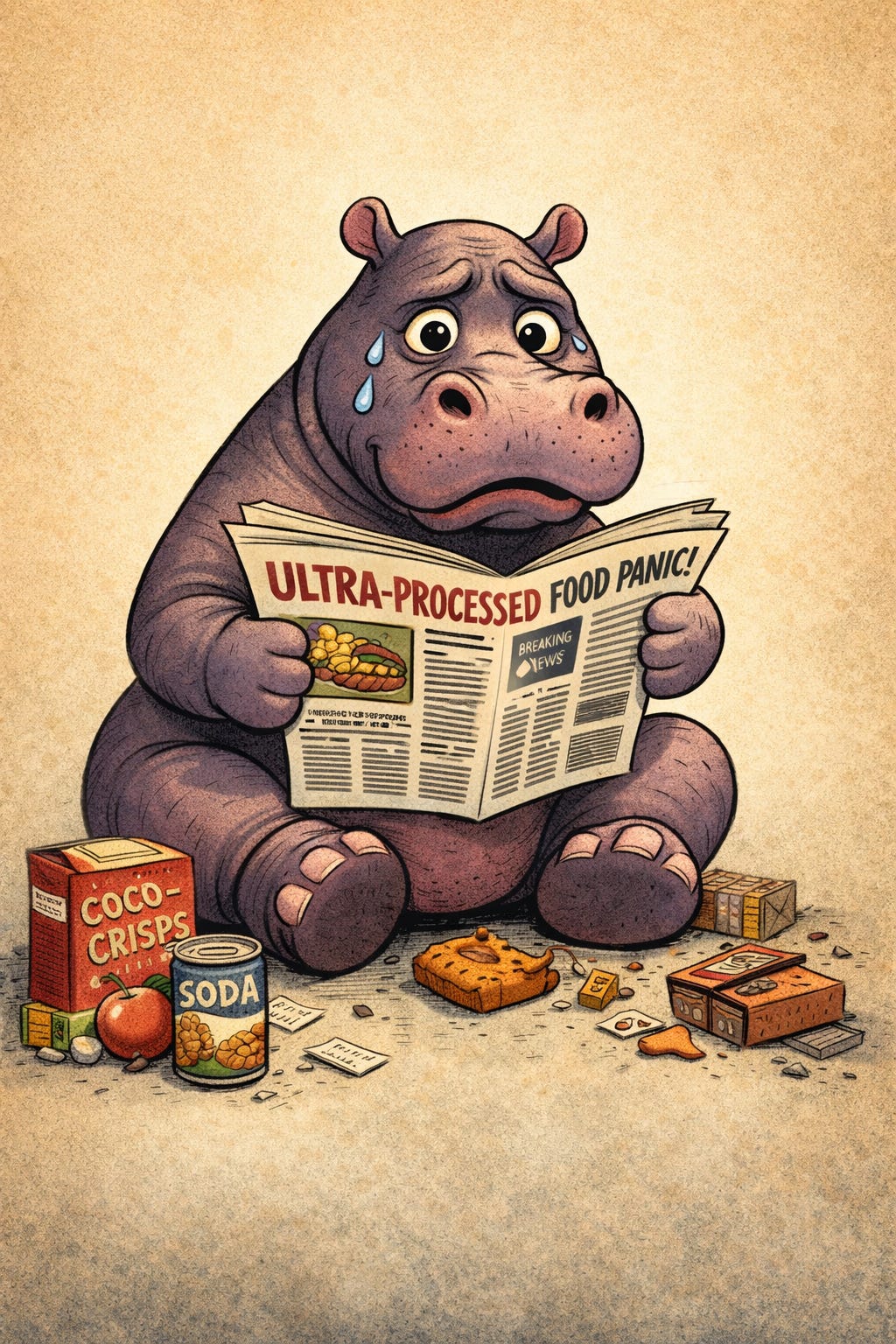
I don’t think my opinion about ultra-processed foods is a secret. I’ve written about it ad nauseam. Not only is there no evidence that categorising food by processing is superior to the old-fashioned idea of using food composition - shoehorning in a new category distracts from many of the real problems we currently face in nutrition. Increasing fibre intake across the population — most of us don’t achieve the recommended 30 g/d - would arguably have a greater benefit to health than avoiding healthy UPFs. (Unhealthy UPFs are already covered by all current guidelines.)
The ambiguous definition and the constantly shifting goalposts of UPF make research difficult and expensive. We need to move beyond observational data, which simply does not work for UPF — but currently we have almost no clinical data supporting the claim that ultraprocessed foods are really unhealthy.
“What about the clinical trials?” you might ask. After all, especially the trial by Kevin Hall and colleagues is often used as evidence for the high risks of UPF. However, this trial — and many others — did not use processed foods as control, but minimally processed foods. To test whether ultra-processing specifically causes harm, you’d need to compare ultra-processed foods against processed equivalents matched for composition — not minimally processed versions.
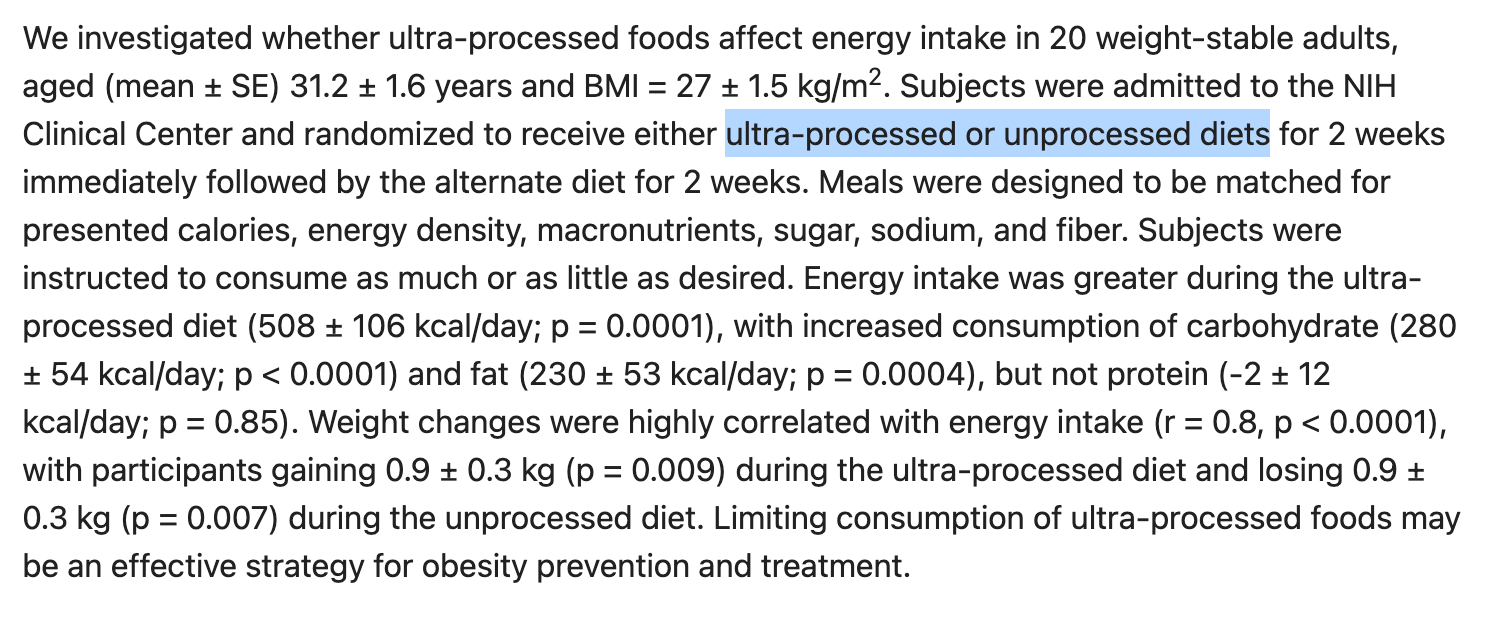
These results are interesting — they tell us a lot about the effects of food processing, but nothing about the difference between processing and ultra-processing. (Which - allegedly — makes all the difference).
The elephant in the room
For most people, the discussion about ultra-processed food focuses on - unsurprisingly - foods: Will coco-pops kills us? Should children have sandwiches at school? Is hand-made artisan sourdough bread really healthier than standard supermarket bread? This gives great headlines and ensures heated discussions — but will do more harm than good.
Demonising food is always a bad idea - for people struggling with eating disorders, this can be dangerous, for others, it’s simply unhelpful. Making people feel guilty for their food choices won’t result in a healthier — otherwise, everyone would eat their five-a-day.
But more importantly, it distracts from a discussion we should have.
The origins of NOVA and ultra-processed foods are the changes to the Brazilian food system and attempts to describe it. And for some, this — and not quibbles about ingredients or wrappings — is the real issue. Admittedly, the food system is often mentioned by ultra-processed food activists, but often in a very simplistic “industry is bad” way.
It is more complicated than that - and the rather simplistic anti-industry approach by activists is making it more difficult to find a solution. Despite all its flaws: our food system would not be able to sustain our lifestyle without the food industry — and changing it requires collaboration.
The often used comparison with Big Tobacco is flawed in many ways, but most importantly: we can easily live without tobacco — we can’t live without food.
Changing the food system is complicated. I am obviously biased here as I am part of a research project that tries to do exactly that — and it turns out that it is far from straightforward. Food availability is important — but so are the availability of storage space and cooking facilities, personal preferences, cost and time.
There is often a lot of criticism of shops — especially small corner shops or convenience stores - that they don’t stock enough healthy options. For example, a few weeks ago, the Food Foundation raised the alarm that most food shops at stations don’t offer fruits:
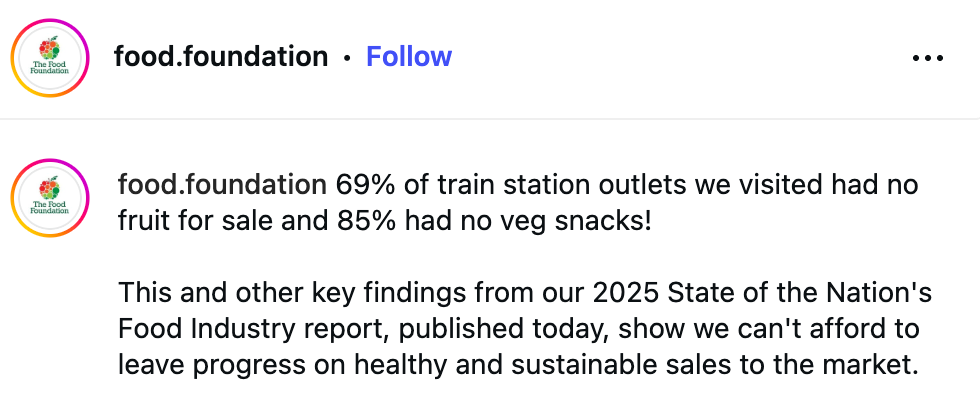
But this ignores an important aspect: a shop will not stock items that don’t sell - especially not items that spoil quickly. Why should they? It is expensive and someone has to cover the costs. And this creates a vicious cycle: healthy foods are not offered because of a lack of demand — and there is a lack of demand because no healthy foods are offered. If shops do stock this kind of food, someone has to cover the costs: either consumers through higher prices or they have to be absorbed as losses that make the whole enterprise less viable.
How can we break this cycle?
A food system should work for everyone. It should give everyone easy access to healthy food. But this is complicated - because the food system is complicated. It is not just a matter of telling shops what foods to stock or forcing suppliers to create foods that follow the latest fad — because that won’t work.
In the UK, we are lucky that we have a large research programme that funds research into the food system — and how it can be improved. This has going on for some time and results look promising — but they also show that changing the food system required detailed knowledge and a good understanding across many different disciplines.
Making headline-grabbing demands and calling for a ban of coco-pops not only trivialises this work — it also takes important funding away from research that actually can make a difference.
Great article as ever, Gunter. As someone who lost 43% of her body weight and went from a BMI of 38 to 22, I can safely say that banning or adding more tax to UPFs would not have stopped me gaining weight. I lost weight while eating plenty of UPFs and still love a bowl of cocopops!
I think we see the difference in the 'food system' when we travel. On a recent trip to Italy, I saw amazing fresh foods available in very mundane environments (airport cafes, local corner shops etc). Everyone eats 'well'. It's part of culture. All European countries have their own specific food approaches embedded at a cultural level. A trip to anywhere else highlights how miserable our food system feels in the UK. While I am not against UPFs, I would like to be able to buy more fruit etc when out and about.
Advertising / marketing plays a huge role in our subconscious food choices. If you gave someone a massive budget to market apples, would it work? Could you actually create more demand for fruit?
It’s eye-opening how much the focus on ultra-processed foods can distract from bigger nutrition issues. Great article!