
Are additives safe?
How I Learned to Stop Worrying and Love the E-Number

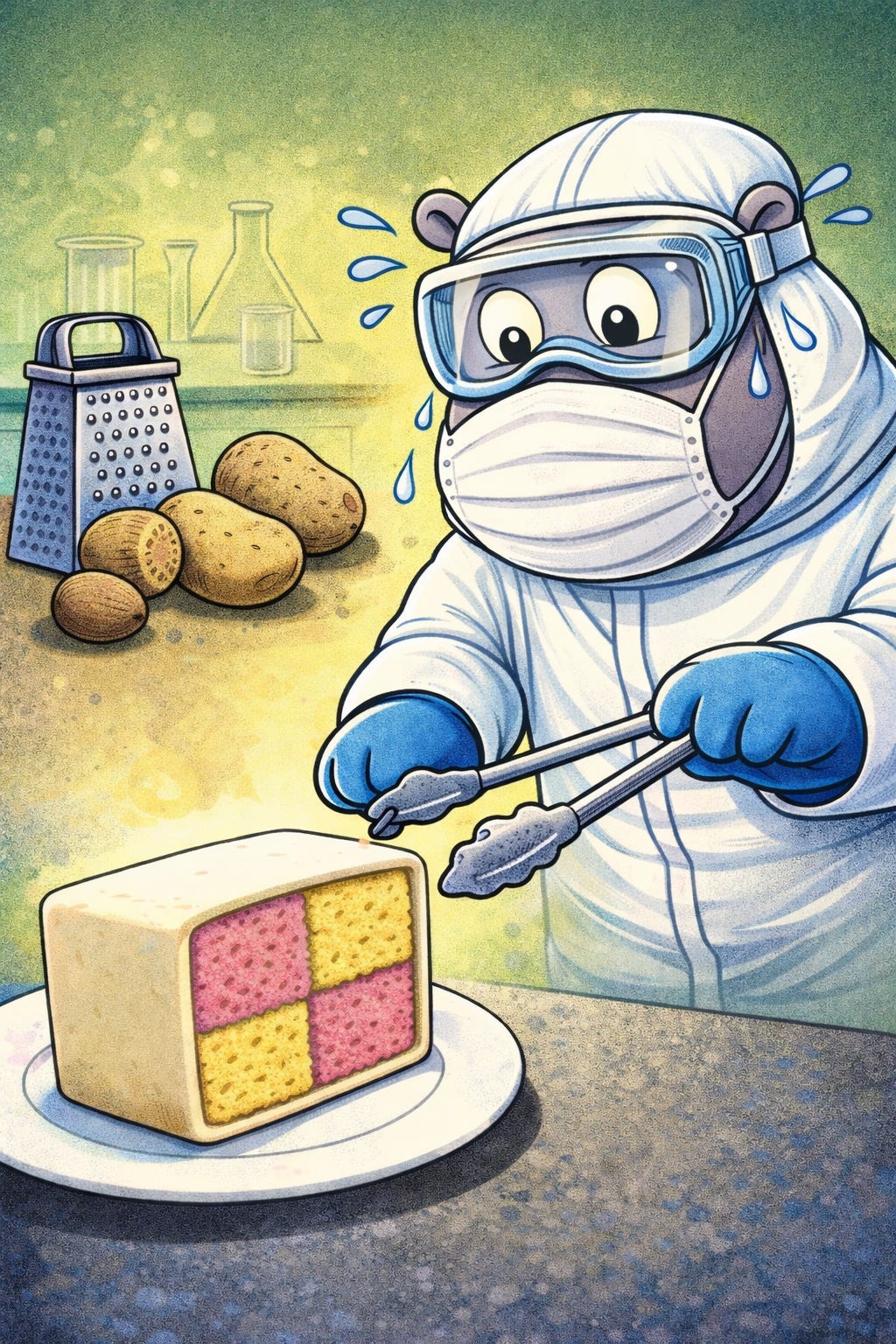
Additives have a very bad reputation. After all, chemicals with incomprehensible names must be dangerous. And who wants to have emulsifiers, preservatives or thickeners in their food anyway? 1
As regular as clockwork, nutritionists and others warn of the inherent dangers of additives and advise that they should be avoided. They often point to some studies which suggest that they could be harmful – and I have written before that these studies need to be taken with a large pinch of salt.
But the question remains: are they really dangerous and best avoided? Or are they actually safe?
It depends on what you consider to be safe.
What is safe?
Is taking ibuprofen safe? Most people don’t think twice about using it – ignoring the risk of aseptic meningitis – a rare but potentially fatal condition.
Eating itself is of course inherently dangerous: in 2022, almost 100 people died from choking in the UK.
Leaving the house comes with clear dangers: pedestrian fatalities run into the hundreds annually and around 1,600 people die on UK roads each year.
We normally use a common sense approach to safety – and that is why most people wouldn’t consider any of these examples as inherently unsafe. We accept a certain amount of risk which we consider acceptable.
However, when we talk about chemicals and especially food additives, this suddenly changes.
Better safe than sorry
The problem with food additives – and chemicals in general – is that the common sense approach no longer works. While most people can decide whether it is safe for them to cross the street, it is much more difficult to understand whether there is a risk from consuming carrageenan (a thickener made from seaweed).
And as soon as someone saws the seeds of doubt, the better safe than sorry mindset sets in. This is where usually the precautionary principle is invoked – or at least some interpretation of it: We don’t know everything about these chemicals – shouldn’t we avoid them just in case?
While this approach might sound reasonable at first, it is neither sensible nor feasible (and incidentally also not following the precautionary principle).
The good and the bad
The better safe than sorry approach sounds cautious, but it only looks at one side of the equation. It asks: what if this additive causes harm? It never asks: what if avoiding it causes harm?
For some additives, the answer is obvious: preservatives prevent food spoilage. Not only does this prevent food borne illnesses (which are not just unpleasant but can be fatal), but also helps to make food more affordable and avoid food waste.
Other additives – such as emulsifiers – help keep food fresh for longer, which helps with affordability and a reduction of food waste.
But what about other additives? Do we really need additives that improve texture, colours that make food more appealing, thickeners that create a pleasant mouthfeel – and raising agents for cakes?


Of course we don’t. There is no need for cakes, ice cream or colourful sweets. But should we? And while we’re at it, should we also ban potatoes (they contain poisonous solanin) and nutmeg (it contains genotoxic and carcinogenic alkenylbenzenes)? And of course nitrate and nitrite – which are simultaneously dangerous and healthy.
We don’t. And we shouldn’t. Because food is not just a source of energy and nutrients, but it is so much more – and it should be enjoyed. And that includes cakes, ice-creams, colourful sweets and even Coco Pops.
Dosis sola facit venenum
Fortunately, there is no need to ban anything – and we can still enjoy foods without worrying about additives.
The reason is a principle that Swiss physician Aurelius Theophrastus Bombastus von Hohenheim described in the 16th century: dosis sola facit venenum – the dose makes the poison. Everything is toxic at some level. There is no harm in drinking a glass of wine, but several bottles will land you in hospital. For most compounds – especially those used as additives – the question is not whether something can be harmful, but whether the amounts we actually consume are harmful.

This is precisely what food safety regulators assess. Agencies like EFSA in Europe and the Food Standards Agency in the UK review toxicological evidence from a wide range of sources – animal studies, human data, mechanistic research – before any additive is approved. This process is transparent, and the results are published in extensive documents: the re-evaluation of E541 from our Battenberg cake has 40 pages.
But it does not stop here: when new evidence emerges, additives are reassessed. The impact of additives on the gut microbiome is not ignored, but assessed and included in future assessments.
For approved additives, regulators set an Acceptable Daily Intake (ADI) – the amount that can be consumed every day for an entire lifetime without appreciable health risk, with a considerable margin of safety.
But setting safe limits is only part of the picture. Regulators also estimate how much of each additive people actually consume. If these assessments suggest that certain groups might be exceeding the ADI, this information can be used to take appropriate action.
Could new evidence emerge that show that an additive turns out to be problematic? Of course – and it happens. For example, EFSA was sufficiently worried about titanium dioxide (E171) to declare it as no longer safe (although this assessment is not shared by other regulators).
There will always be new data – and some of it will challenge current risk assessments. We see the same in medicine where drugs are taken off the market when new evidence emerges. That is how science should work.
But it is important to put new results into context: studies generating alarming headlines often have significant limitations: doses far exceeding realistic human exposure, animal models that do not translate well to humans, or methodological problems that make interpretation difficult.
So enjoy your cake. Have an ice cream and some multi-coloured sweets. The additives in them have been assessed more rigorously than almost anything else on your plate.
Actually - most of us do - because they are as important to processed foods as they are to home cooking: no mayonnaise without emulsifier (lecithin from egg yolk); no home-made jam without preservative, (sugar); and no Béchamel sauce without thickener (flour).